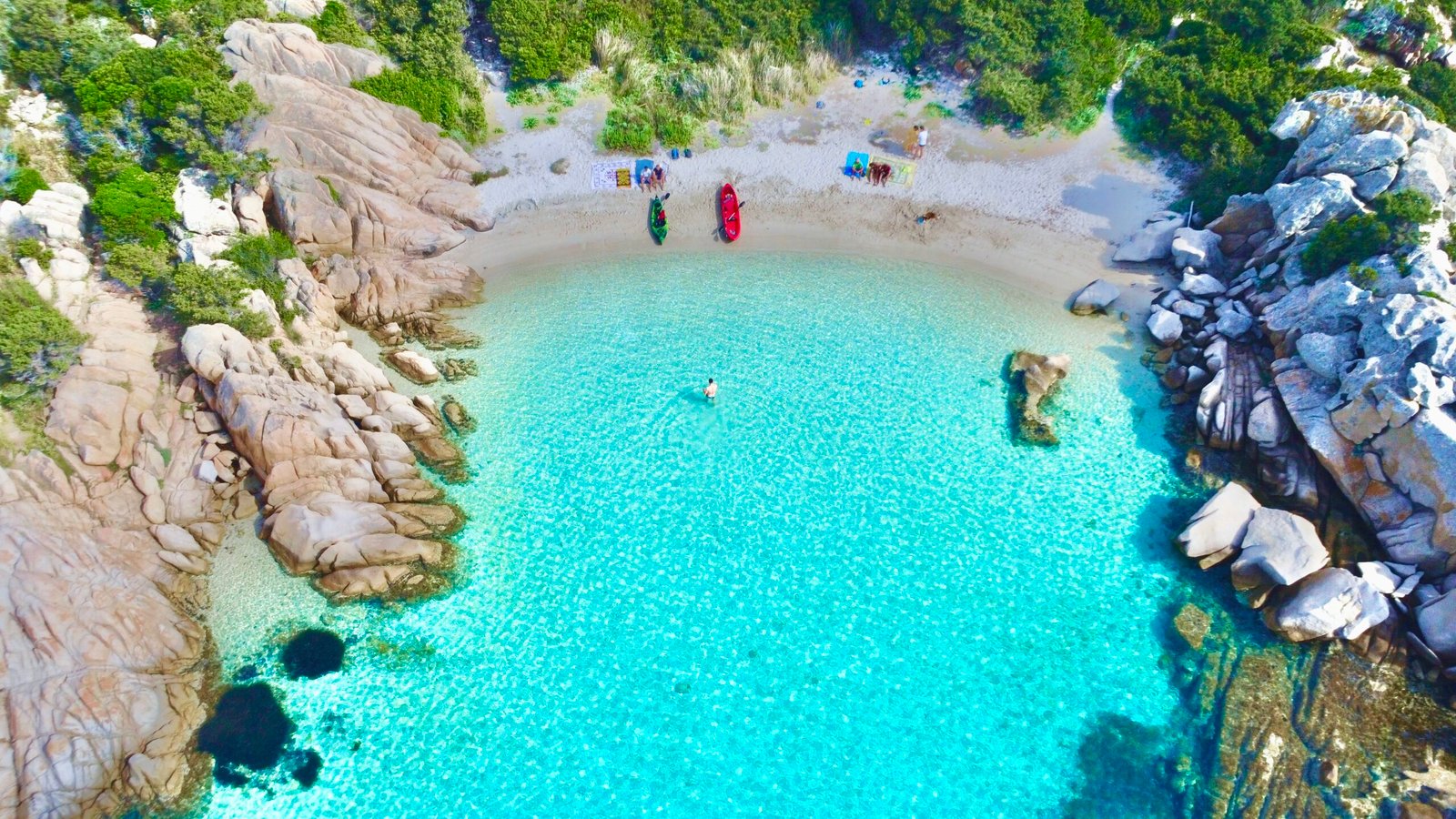
Many tourists arrive in Sardinia with a vague idea of "going kayaking", but without the slightest experience. The good news is that touring kayaks don't require any previous technical training: after 10 minutes of practice by the shore, anyone of normal fitness can head out safely on a flat sea.
This guide is written for people who have never held a paddle, or who did it once years ago and want to start again without mistakes. We explain the right technique, the routes that suit beginners and how to choose the right kayak for your first experience in Sardinia.
Do you need experience to go kayaking in Sardinia?
No, as long as you respect a few basic conditions. Touring kayaking on calm water with moderate wind is suitable for any adult in good physical health, even with no previous experience. You don't need to be a champion swimmer: a life jacket is always mandatory.
The only real reasons not to go are:
- Serious back problems (herniated disc, stenosis): the seated position with the torso slightly bent can make some kinds of lower back pain worse
- Limited mobility in the arms: a kayak is controlled almost entirely with the arms
- Rough sea (waves over 0.5 m) or strong wind (over 15 knots): not suitable for beginners
If you're unsure about your fitness, choose a double kayak: you can always take turns paddling and take breaks without losing your course. Also read kayak or SUP: which to choose to work out which of the two suits your situation best.
Which kayak to choose as a beginner
As a beginner you basically have two choices: a single kayak or a double kayak. Both are suitable for newcomers, but they have different features.
Single kayak — independence and personal control
A single touring kayak is stable. With one, you have complete control over your route and can go at your own pace. It's the right choice if:
- You're on your own or want to explore independently
- You've already been kayaking a few times, even years ago
- You're in good shape and feel at ease in the water
Double kayak — teamwork and safety
A double kayak is the best choice for couples, friends or anyone who wants to feel more secure on their first outing. With two people paddling, you keep up a good pace even if one of you gets tired. A double is also more stable than a single, so less likely to capsize. Rental price: €35/person for 4 hours, €50/person for a full day.
SUP for beginners — yes, but only on calm water
A SUP (stand-up paddle board) takes more balance than a kayak and isn't the ideal choice for your first time on open sea. If you want to try it, choose the shallow water off a sandy beach, on a flat sea, and stay close to the shore.
Basic technique: how to paddle in 5 steps
You don't need a course. Just 5 basic ideas that you can learn in 10 minutes by the shore before you set off.
1. Holding the paddle
Hold the paddle with your hands shoulder-width apart. Palms face down, elbows slightly bent. Don't grip too tightly: your hands should be able to slide a little.
2. Putting the blade in the water
Put the blade in the water level with your hip, not your knee. The further forward the entry, the longer the pull and the less tired you get. The blade should go in vertically, not at an angle.
3. Pull with your torso, not your arms
The most common beginner mistake is pulling the paddle with the arms alone. Rotate your torso with the stroke: the pulling arm stays almost straight while your torso does the work. It's far less tiring and gives you more power.
4. Taking the blade out of the water
Lift the paddle out of the water when it reaches your hip. Going further adds no forward thrust, but tires your back muscles. "In at the front, out at the hip": that's the rule.
5. Steering: how to turn
To turn right, take 2–3 strokes in a row on the left side (and vice versa). For a sharper turn, use the blade as a rudder: put it in flat at the side and push outwards, keeping the kayak still.
Tip: before setting off, try it for 5 minutes in very shallow water (30–40 cm) near the shore. You'll immediately understand how the kayak responds and you'll feel much more confident once you're out on open water.
The easiest routes for beginners around Olbia
For your first outing, always choose short routes (2–4 km in total), with sheltered water and a start from an easy-to-reach sandy beach. These are the routes we recommend for beginners:
Cala Girgolu — between Porto San Paolo and San Teodoro
Distance: 2–3 km · Level: Very easy
Cala Girgolu is one of our delivery points: a small granite bay with rocks shaped by the wind. Staying close to the shore you reach Spiaggia della Tartaruga and Spiaggia delle Vacche, with stops close together and clear water. Read our Cala Girgolu guide.
Porto Istana — north bay
Distance: 2–3 km return · Level: Easy
The bay of Porto Istana is made up of four coves close together, separated by low rocks, with shallow, clear water near the shore. The coves are exposed to the wind: choose a calm morning and you have the perfect corner of Sardinia for a first outing.
Golfo Aranci — from Cala Moresca towards Capo Figari
Distance: 3 km return · Level: Easy to medium
Ideal as a second or third outing, once you've had some practice. The coast towards Capo Figari offers spectacular scenery with rocky cliffs, crystal-clear water and the first coves reachable by sea. Set off early in the morning (before 9:30), back by 12:00. Discover the hidden coves of Golfo Aranci to know what awaits you along the way.
The most common beginner mistakes (and how to avoid them)
These are the most common mistakes. Here they are, each with a simple fix.
Mistake 1 — Setting off too late in the morning
The maestrale, the north-westerly wind, tends to strengthen during the day when it blows. A beginner who sets off late risks finding rough sea on the way back, just when they're already tired. Set off early (deliveries start at 9:00) and plan to be back by 12:00–12:30.
Mistake 2 — Paddling too hard at the start
A marathon pace wears out your arms in 20 minutes. The right pace is slow and steady, with 30-second breaks every 10–15 minutes. If you're out of breath, you're going too hard. Touring kayaking isn't a speed sport: it's a way of exploring.
Mistake 3 — Not checking the weather before going out
A sunny sky doesn't mean a safe sea: the wind can pick up within 30 minutes. Always check Windy.com on the morning of your trip. The limit for beginners is 10–12 knots at most. Above that, postpone: the Mediterranean isn't going anywhere.
Mistake 4 — Not bringing enough water
Paddling in the sun makes you sweat more than you'd think. At 30 °C in direct sun, an adult can easily lose 1 litre of water an hour. Bring at least 2 litres each for half a day. Dehydration reduces concentration and increases the risk of mistakes.
Mistake 5 — Going too far from the shore
On your first outing, always keep the shore in sight and no more than 300–400 metres away. That way you can get back easily if you suddenly get tired, the weather changes or anything unexpected happens. With experience, you can go further out.
What to bring on your first kayak outing
A Kayak Delivery rental already includes paddle, life jacket and dry bag. For everything else, this is the essential list:
- Waterproof sunscreen, SPF 50+ — applied before you go out
- Water — at least 2 litres each
- A light snack — nuts and dried fruit or energy bars
- A cap or sun headband — the sun's reflection off the water is intense
- Sunglasses with a strap — so you don't lose them if you get splashed
- Swimsuit and towel — a swim or two along the way is almost inevitable
- Phone in a waterproof pouch — included in the rental
For the full, detailed list, including gear for longer trips, read our guide on what to bring kayaking in Sardinia.
After your first outing: how to improve and where to go
Your first kayak outing always leaves the same feeling: "why didn't I do this sooner?". If you want to keep exploring Sardinia by kayak, here's how to progress naturally.
From the coves to the open sea
After 1–2 outings at Porto Istana or Cala Girgolu, you're ready for the coast of Golfo Aranci. The main difference is the wind and the small waves: learn to read the sea, to find your bearings using the headlands and to choose a route that keeps you sheltered from the wind.
Intermediate routes for the next step
Once you have 3–4 outings behind you, you can start on the routes described in our guide to the beaches you can only reach by kayak in Olbia: isolated coves, sea caves and deserted beaches accessible only by sea. The kayak becomes a real tool for exploration, not just a sport.
The advanced outing: Tavolara
The ultimate goal for kayakers in north-east Sardinia is Tavolara: a crossing of about 4 km on open water and spectacular seabeds. It takes 5–6 outings' worth of experience and excellent weather conditions. Read our full guide to the kayak trip to Tavolara to see what awaits you.
Frequently asked questions
Do you need experience to go kayaking in Sardinia?
No: touring kayaking on calm water with moderate wind is suitable for any adult in good health, even without previous experience. A life jacket is always mandatory.
Single or double kayak for beginners?
Both work. A single gives you independence and control; a double is more stable, less likely to capsize and lets you take turns paddling. It's the best choice for couples or for a first outing.
What are the easiest kayak routes near Olbia?
The coves of Porto Istana, the coast at Cala Girgolu and, for a second or third outing, the coast of Golfo Aranci from Cala Moresca towards Capo Figari.
Your first kayak in Sardinia
Beach delivery included, no course needed. We bring the kayak ready with life jacket and paddle: you're on the water in 10 minutes.
Book now — from €40